
 Open in Claude
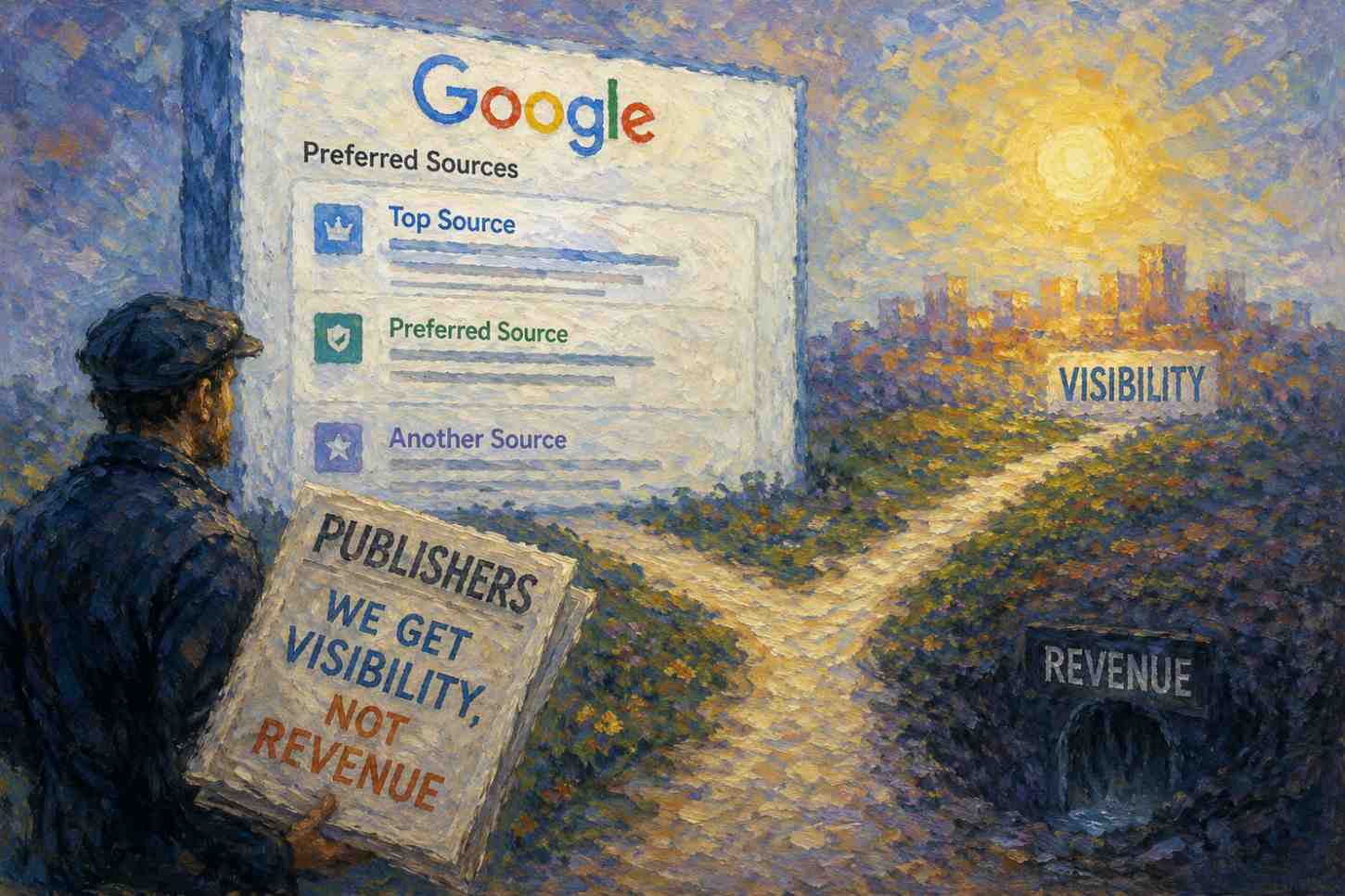
On May 27, 2026, Google extended its Preferred Sources feature into AI Overviews and AI Mode — the two surfaces that now mediate how billions of people encounter information through Search. Performance Marketing World framed the move as a new visibility advantage for publishers. The structural problem is that visibility was never what publishers lost. They lost the monetization that visibility used to fund.
- Preferred Sources now puts a visible badge on user-designated publishers inside AI Overviews and AI Mode, and Google has said the signal will eventually weight ranking across its AI surfaces.
- Google reports more than 345,000 sources added and Preferred-Sources links roughly twice as likely to be clicked — figures that are self-reported and which publishers say they cannot see in their own analytics.
- Independent data shows the underlying erosion is unchanged: Similarweb measured a 26% drop in news-site traffic in the 12 months after AI Overviews launched; Chartbeat data shows small publishers lost roughly 60% of search referral traffic over two years.
- The badge rewards publishers users already recognise and does little for newer or generalist sites — the citation economy still has no native payment rail.
- For brands, the right read is to ringfence AI Search visibility as its own budget; for publishers, the right read is to price the future on citation, not on traffic recovery.
What Preferred Sources actually is
Preferred Sources is a personalization feature inside Google Search, now extended to AI Overviews and AI Mode, that lets users name the publishers they want foregrounded when an AI answer is generated. When a designated source appears in the response it carries a visible badge; in the new developing-topic carousels those sources are prioritized; Google has said it will eventually use the signal as a ranking input across its AI surfaces.
The link economy gave you placement; the citation economy gives you a badge
In the open-web economy, visibility was a ranked position on a SERP, monetized by the click that followed. In the agentic-web economy, visibility is a citation or a badge inside a synthesized answer, monetized — for now — by nothing native to the surface. Preferred Sources is an upgrade to the visibility side of the equation. The monetization side has not moved.
What Performance Marketing World reported, and what the data confirms
The article frames the update as a visibility advantage for publishers and reports Google's claim that Preferred-Sources links receive roughly twice the click-through of other sources. That figure is Google's own — independent verification is not yet possible, and Digiday reported in 2026 that several publisher heads cannot see Preferred-Sources traffic in their analytics at all. What the public data does confirm is the backdrop. Similarweb measured a 26% drop in news-site traffic in the year after AI Overviews launched. Chartbeat reported a roughly 60% search-referral decline for small publishers over two years. Cloudflare's 2025–2026 measurements put Google's crawl-to-referral ratio at about 14 to 1, against roughly 1,700 to 1 for OpenAI and 73,000 to 1 for Anthropic. The traffic loss is real and uneven; a badge does not change that arithmetic.
Where the optimists are right — and where the argument breaks
The strongest version of the visibility case
The optimist case is credible. Preferred Sources gives recognised publishers a labelled position inside the AI answer. If Google's 'twice as likely to click' figure is even directionally true, badged publishers recover meaningful referral traffic on queries where they are selected. Combined with the new developing-topic carousel and 'Highly Cited' labels, the feature gives high-trust brands a structural reason for users to return to the open web. For publishers with a known name, that is a non-trivial win.
Why visibility without a payment rail is not a fix
The break is in supply-side economics. A badge does not close a 26% traffic gap, and it does not pay the publisher for the citation itself. Preferred Sources concentrates the residual referral on names users already type from memory — a Reuters, a Times, an FT. The newer, more vertical publishers whose work AI engines actually rely on for grounded answers get no badge. They get cited, used, and unseen. Until the citation itself is monetized, visibility is influence stripped of revenue.
What this changes for brands, and what it changes for publishers
For CMOs, media buyers, and agencies: ringfence the AI-visibility line
- Treat AI Search visibility as a discipline distinct from SEO and SEA, with its own budget, KPIs, and owner — Preferred Sources is one of several user-side levers (badges, carousels, opt-in defaults) that already shape which brands appear inside the answer.
- Audit how much of your discovery funnel already passes through AI Overviews or AI Mode; Google reported AI Mode crossed one billion monthly users at I/O 2026.
- Stand up the AI Search advertising practice — Generative Engine Advertising — as a service line before clients ask why a competitor is being cited and you are not.
For publishers: price the future on citation, not on traffic recovery
Preferred Sources is a useful audience-relationship tool for incumbents and a near-nothing for everyone else. The strategic answer is to stop pricing the future on traffic recovery and start pricing it on being the source of record AI engines cite. That requires structured AI-Search ad inventory inside the answer — a revenue model that pays publishers for the citation, not the click that never comes.
Three signals to watch over the next 18 months
- Whether Google turns the Preferred-Sources signal into a real ranking weight, and whether it ever pairs that with reportable analytics — the absence of publisher-side tracking is the current red flag.
- Whether publisher–AI licensing migrates from lump-sum deals to usage-based pricing tied to citation share; Cloudflare's pay-per-crawl experiments and the OpenAI and Anthropic content deals of the last 12 months point that direction.
- Whether the first AI Search ad standard — sponsored citations, native ad units inside the answer, publisher-share economics — is set by an incumbent or by a new entrant. Pricing power will sit with whoever standardizes it first.
Conclusion
Hold on to this: Google's Preferred Sources is a visibility tool inside the agentic web, not a monetization tool for it. The link economy gave publishers placement and the click that paid for it; the citation economy, so far, gives them a badge and a thank-you. Smalk AI is the answer to the missing rail — an AI Search ad network for Generative Engine Advertising that places native ads for AI agents and opens a citation-based revenue stream for the publishers whose content fuels those answers. What to watch next: who sets the first pricing benchmark for sponsored citations — that is the moment the category prices in, and the moment the badge stops being the only thing publishers have.