
 Open in Claude
You do not write ads in Google AI Mode. Gemini assembles them from the Merchant Center feed, labels them Sponsored, and is now moving checkout onto the same surface through the Universal Commerce Protocol. That is not a new campaign type. It is Google folding discovery, recommendation, and purchase into one loop — and leaving the review publishers who still ground the recommendation outside the money.
- Google AI Mode advertising for ecommerce is eligibility plus feed quality, not a placement you buy or copy you write.
- Sundar Pichai said at I/O 2026 that AI Mode had passed one billion monthly active users; Datos clickstream still put it under 0.2% of US desktop search events in Q1 2026 — user counts and query share are not the same number.
- AI Performance Insights, now in a limited US Merchant Center pilot, reports organic AI share of voice only. Paid AI Mode ads still have no dedicated report.
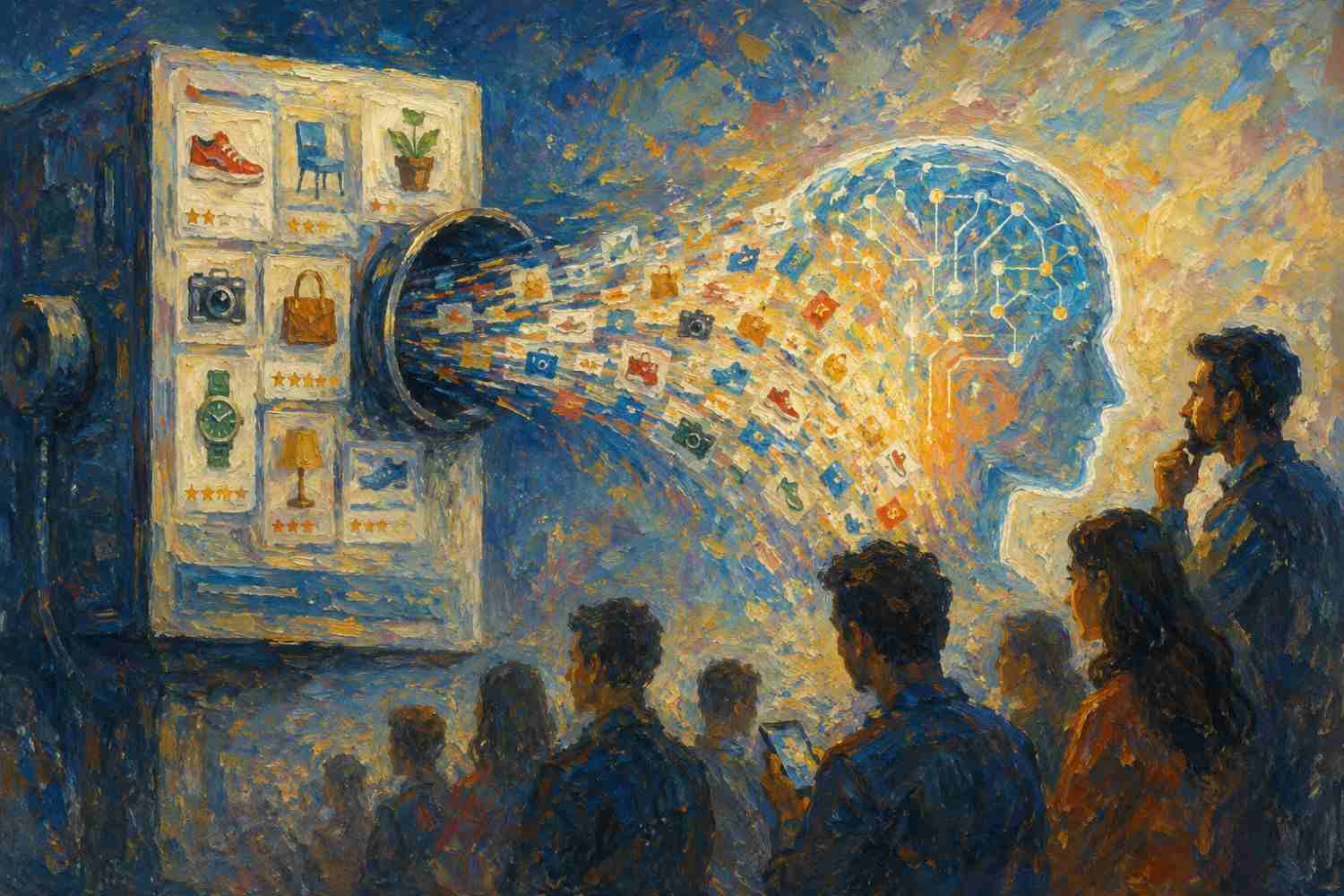
- The parallel to the old Shopping SERP is exact: brands used to rent the click; they now rent a sentence inside the answer, and the cart can stay on Google.
- Buying-guide and review publishers remain the unpaid source layer under that sentence.
What Google AI Mode advertising actually is
Google AI Mode advertising is a sponsored insertion inside Gemini’s conversational answer, generated from a retailer’s product data rather than from advertiser-written copy. Eligibility comes from running Performance Max, AI Max for Search and Shopping, Shopping campaigns, or the Dynamic Search Ads migration into AI Max, with Smart Bidding on. There is no AI Mode campaign type and no placement picker.
At Marketing Live on May 20, 2026, Google named four Gemini-built formats: Conversational Discovery Ads, Highlighted Answers, AI-powered Shopping Ads, and Business Agent for Leads. Several of those formats remain in US testing. Direct Offers, piloted since January 2026 with brands such as Chewy, Gap, and L’Oréal, sit beside them as a deal layer that can check out natively for Universal Commerce Protocol merchants.
Shopping ads on the SERP versus shopping ads inside the answer
In the open-web search economy, ecommerce media bought a ranked slot above blue links. Copy was written, keywords were matched, the click landed on a product page, and last-click attribution closed the books. Publishers of reviews and buying guides monetized the research traffic that sat between the query and the cart.
In the agentic-web economy, the shopper asks a three-times-longer question, Gemini writes the explainer from feed attributes, and Universal Commerce Protocol lets the transaction complete inside Search or the Gemini app. Google’s own May 2026 AI Mode insights report is the source of the 3x query-length claim. The unit of value moves from click to citation-plus-checkout. The publisher who still supplies the comparison logic is no longer in the path of either.
What Search Engine Journal reported, and what we verified
Tony Adam’s August 26, 2026 Search Engine Journal piece is the cleanest operator’s map of the new surface: you do not write the ads; merchandising usually owns the data that writes them; vague titles produce vague Gemini copy; conversational attributes — question-and-answer pairs, related products, document links, popularity signals — are the new creative brief. That operational read holds.
The scale claims need a split. Pichai’s I/O 2026 keynote is the primary source for AI Mode passing one billion monthly active users, and for AI Overviews passing 2.5 billion. Datos’ Q1 2026 State of Search report, covered by PPC Land on April 27, 2026, put AI Mode at 0.16% of US desktop visits in March and 0.21% in the EU/UK — under 0.2% in the US. The two figures measure different things and have never been reconciled. Google’s 75% “faster, more confident decisions” stat is an Ipsos survey Google commissioned in December 2025, not an independent panel. Treat it as directional, not as a market-share number.
Why a better Merchant Center feed looks like the whole job
The strongest case for treating the feed as media
Adam’s argument is right on the mechanics. Paid and organic visibility in AI Mode share the same product-data foundation. If Gemini is the copywriter, material, fit, durability, and FAQ pairs are the brief. Google’s August 2026 retail holiday guide even pointed at Etsy’s 36% year-over-year gross merchandise sales lift in the 2025 holiday season as partly attributable to AI Max — a vendor case study, not an audited incrementality test, but enough to pull SEA budgets upstream into merchandising.
A Google-only feed strategy is not AI Search advertising
Feed work is table stakes inside Google. It is not a media plan for the agentic web. ChatGPT, Perplexity, and Claude do not read Merchant Center. They read publisher pages, reviews, and structured public content. A brand that only tightens titles in Google Ads has bought eligibility on one surface and stayed invisible on the others. Worse, Google’s new reporting still hides the paid line: Merchant Center’s AI Performance Insights pilot, documented in Google’s own help center in July 2026, covers organic AI traffic only. Paid ads are excluded. You can improve the catalog and still not know what the sponsored sentence returned.
What this means for ecommerce brands and for publishers
For CMOs and SEA leads: move creative ownership to the catalog
Ringfence AI Mode as its own visibility line, not as a toggle inside Performance Max. Put merchandising on the media brief. Demand a paid-versus-organic split the moment Google ships it. And do not confuse UCP checkout — live with US merchants such as Wayfair, Chewy, Quince, and selected Shopify stores, with Australia first in APAC — with a completed customer relationship. Google remains the storefront. The brand remains the seller of record only if it treats first-party identity as non-negotiable.
For review and buying-guide publishers: citation without a rail is not revenue
Gemini’s explainer still leans on the comparison copy the open web spent twenty years producing. That copy is now ingested, synthesized, and cited while the shopper checks out on Google. Traffic-funded display against buying guides will not recover this surface. The inventory that matters is the citation itself, priced as a native ad for AI agents rather than as a residual click.
Three ecommerce signals to watch into 2027
Watch whether AI Performance Insights adds paid AI Mode delivery, or stays an organic vanity metric. Watch how far Universal Commerce Protocol checkout spreads beyond the current US and Australia cohorts — that is the moment the product page becomes optional. Watch which non-Google engines ship a shopping graph with a sponsored citation, because the brand that only optimized Merchant Center will discover it built a Google-only asset.
Conclusion
Hold on to this: Google AI Mode advertising is the open-web Shopping auction rewritten as a closed loop of feed, generated sentence, and on-platform checkout. Feed quality is the price of admission on Google, not a strategy for the rest of AI Search, and it does nothing for the publishers whose comparisons still sit under the answer. Smalk AI is the missing rail — an AI Search ad network that places native ads for AI agents across engines and opens a revenue stream for the sources those agents cite. What to watch next is whether paid AI Mode reporting ever ships as its own line, or whether Google keeps the sponsored sentence unmeasurable while the cart stays on its side of the page.