
 Open in Claude
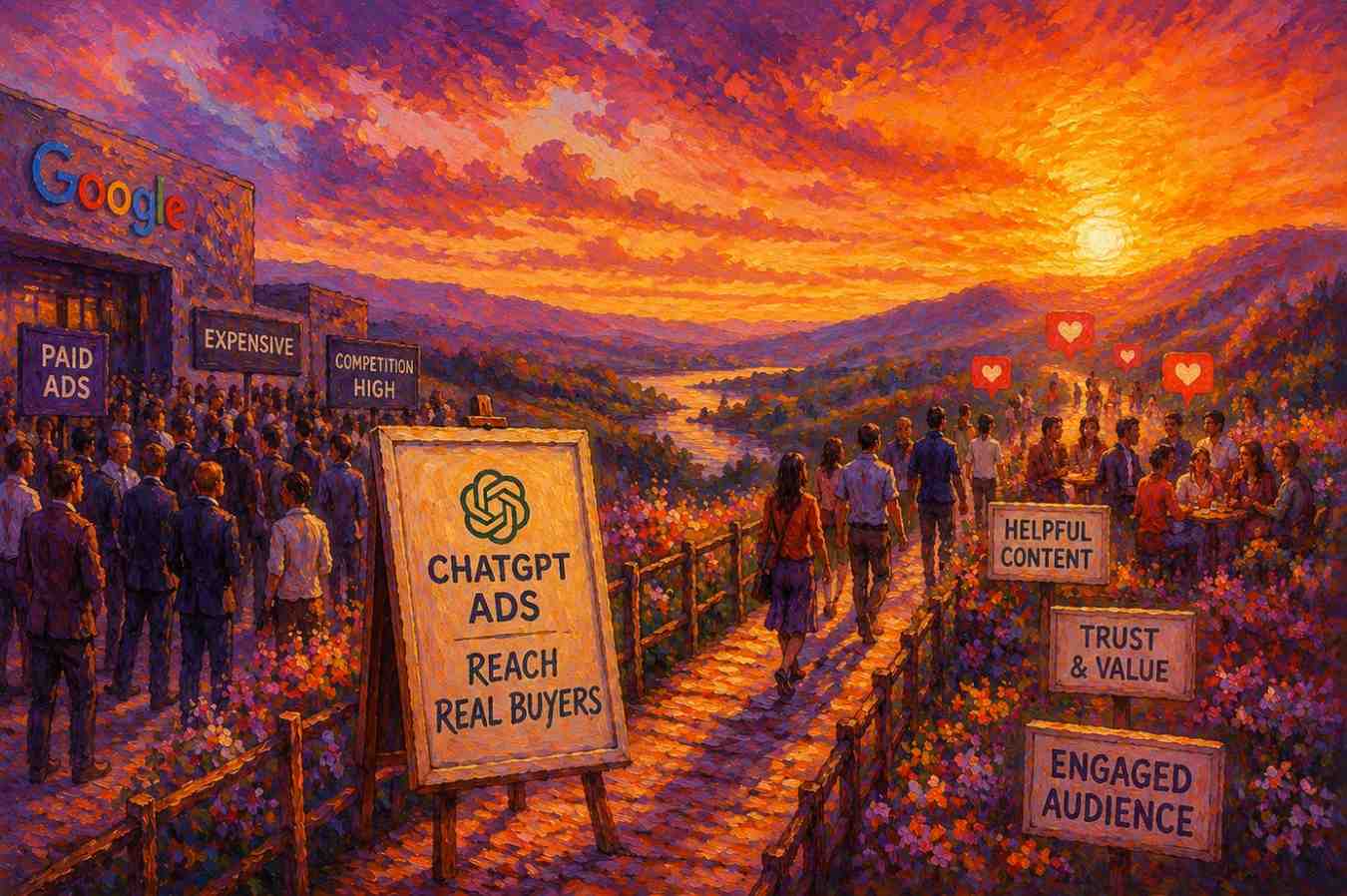
Similarweb says 83% of the queries that trigger a ChatGPT ad would never have fired a Google Shopping ad. That gap is not a quirk. It is a new ad economy forming on top of demand that keyword search was never built to reach — and ChatGPT ads are being sold on publisher content no one is paying for.
- Similarweb found 83% of ChatGPT ad triggers would never activate a Google Shopping ad — this is net-new demand, not stolen demand.
- OpenAI's ad pilot crossed $100M in annualized revenue six weeks after launch (Reuters, March 2026), proving the inventory monetizes.
- Ads now fire deep in conversations — around turn 15 — reaching buyers who have already compared options.
- The money flows from brands to the platform; the publishers whose content grounds those answers receive none of it.
- Brands should claim AI visibility now; publishers should price for a seat in the ad value chain, not a one-off licensing check.
What the 83% gap actually measures
The 83% gap is the share of ad-triggering ChatGPT queries that carry no keyword a Google Shopping campaign could bid on. It measures intent that surfaces through conversation, not declaration. A shopper who types 'running shoes' declares intent. A user who describes knee pain across eight turns reveals it.
This is the intent-inference economy: commercial moments a system infers from context rather than matches against a keyword. Similarweb found 41% of ChatGPT ad moments are purely research-oriented, and 46% of users who start with no commercial intent develop buying signals before the chat ends.
Declared intent versus inferred intent: two ad economies
In the open-web economy, the keyword was the unit of intent. The advertiser bid on a word, Google matched it, the click was billed, and publisher traffic funded the content underneath. The loop was closed, and everyone in it got paid.
In the agentic-web economy, the conversation is the unit of intent. The model infers a commercial moment, places a native ad inside the answer, and the advertiser pays the platform. But the content that taught the model to recognize that moment sits outside the loop. The ad layer exists; the publisher rail does not.
What the ChatGPT ads data shows, and what holds up
Similarweb's June 2026 data, surfaced by PYMNTS, shows ads firing far later in conversations than weeks earlier — from a median of turns 7-8 to 14-22 for the same brands. Vanta's average reached turn 15.8, Monday.com's 13.6. Depth like that reaches buyers who have already shortlisted before a sponsored line appears.
The revenue claim checks out independently. Reuters reported on March 26, 2026 that OpenAI's US ad pilot passed $100M in annualized revenue within six weeks, with fewer than 20% of eligible users shown ads daily. In May, OpenAI opened a self-serve Ads Manager and dropped its $50,000 minimum spend. The inventory is real and scaling.
Why a rising ad tide doesn't lift publishers
The optimist's case: ChatGPT already sends more traffic than it takes
The strongest counter-argument, made by AI-search optimists through 2025 and 2026, is that ChatGPT is a net benefit to the open web. It is the largest AI referrer of traffic to publisher sites — roughly 1.2 billion outbound referrals between September and November 2025, up 52% year on year, per Similarweb data cited by Digiday. On this view, citation drives discovery, and discovery drives clicks.
Why those referrals are a rounding error against the losses
The numbers do not survive contact with the losses. The Reuters Institute reported in January 2026 that news executives expect search referrals down 43% within three years, with a fifth bracing for drops above 75%. AdExchanger documented publishers losing 20% to 90% of traffic, with smaller titles already shutting down. ChatGPT's referrals are real, but they are a drop in a draining bucket — and none of the $100M ad pool reaches the sources.
What this means for brands and for publishers
For CMOs, media buyers, and agencies: claim the AI-visibility line before the auction normalizes
Treat AI Search visibility as a discipline with its own budget and owner, separate from SEO and SEA. Similarweb notes a roughly 30-day category-level advantage for early movers before auction dynamics normalize. Eight of the top 10 ChatGPT advertisers are already B2B SaaS brands; the land grab is underway. Ringfence a 2026 test budget and audit how much of your funnel already runs through inferred-intent surfaces.
For publishers: you are the 83% — price for the value chain, not the lump sum
The content that makes turn-15 commercial inference possible is yours. That is leverage, but only if it is priced. Stop treating AI deals as one-off licensing checks measured against a traffic number that keeps falling. Demand a structural seat in the ad value chain forming inside the answers your content grounds — citation-based revenue, not a settlement.
Three shifts that decide who captures the citation economy
Three signals point to where this lands. First, AI licensing is migrating from lump sums to usage-based terms, with intermediaries like TollBit and ProRata and Cloudflare's pay-per-crawl building the metering. Second, platform-owned ad inventory is expanding fast, concentrating pricing power unless an open alternative emerges. Third, Cloudflare data shows training now drives roughly 80% of AI bot activity — content is consumed at a scale that dwarfs what is returned. Whoever standardizes the payment rail between ad demand and publisher supply sets the terms.
Conclusion
Hold on to this: ChatGPT ads have proven that intent-inference advertising works, but the economy being built on it is missing half its plumbing — the rail that pays the publishers whose content makes it possible. That rail is the category Smalk AI is building: an AI Search ad network that places native ads for AI agents and opens a new revenue stream for the publishers feeding those answers. Watch which player standardizes the payment layer between ad demand and publisher supply first — that is the moment the citation economy prices in.