
 Open in Claude
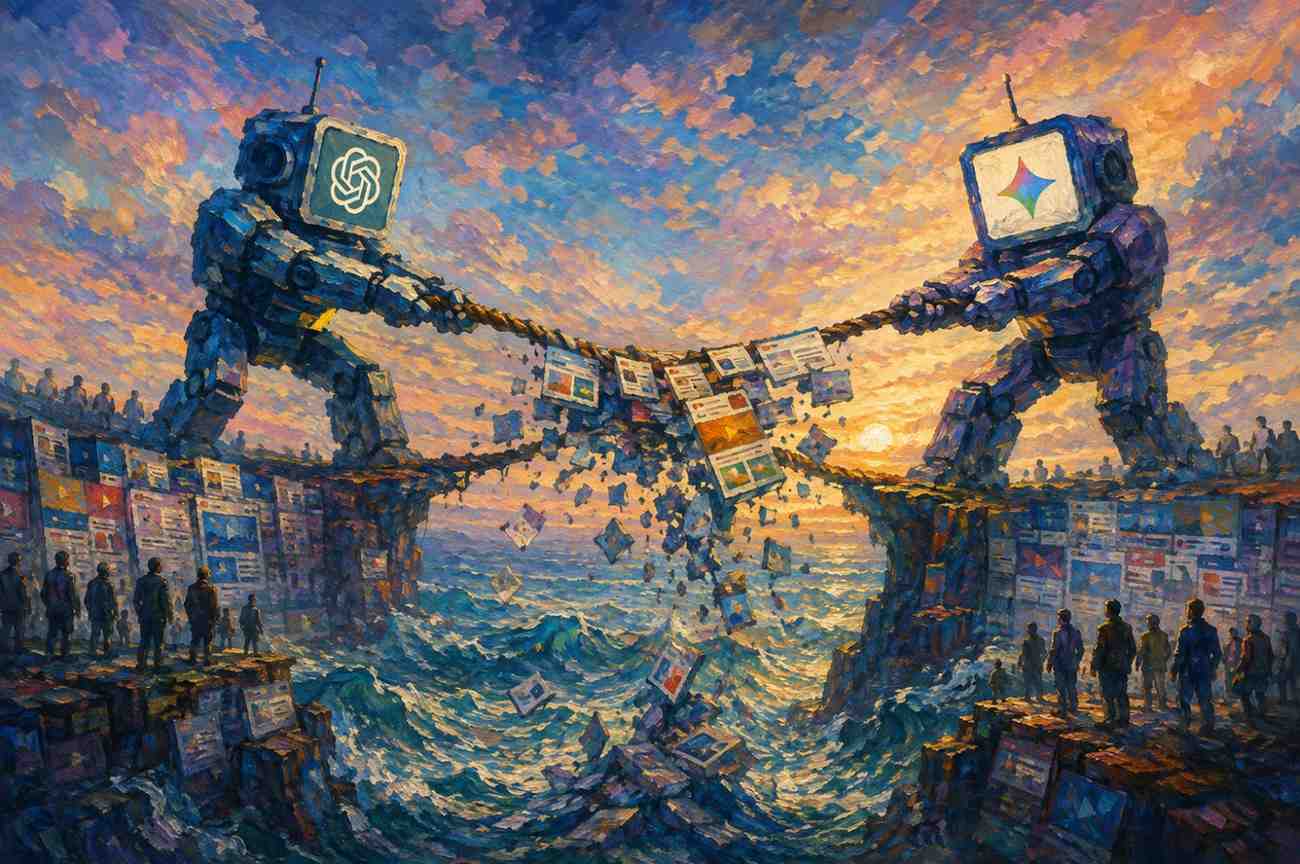
The AI search war is not simply Google versus OpenAI. It is the open web’s click-funded link economy colliding with a multi-engine citation economy that still has no native way to pay the sources whose content fuels the answers.
- Chartbeat data shows Google search pageviews fell 34% from December 2024 to December 2025; small publishers lost 60%, while AI referrals stayed under 1% of total pageviews.
- WPP Media projects generative search ad revenue will exceed $100 billion globally by 2030; eMarketer sees U.S. AI ad spend reaching $68 billion, with most still adjacent rather than inside answers that share value with publishers.
- Muck Rack’s analysis of 25 million AI citations finds journalism at 27% and corporate content at 24%—influence is concentrated, revenue is not.
- Multi-engine competition multiplies extraction without restoring the referral traffic that once funded the open web.
- Brands need cross-engine visibility; publishers need a recurring payment model tied to citation, not one-off licensing deals.
What the AI search war actually is
The AI search war is the simultaneous contest among Google, OpenAI, Anthropic, Perplexity and others for conversational query share, intensified by the August 2024 U.S. monopoly ruling against Google and the subsequent push for stronger remedies. It is also the structural rewrite of how information is discovered, synthesized and monetized across the open web.
The link economy versus the multi-engine citation economy
In the open-web link economy a dominant engine ranked blue links, users clicked, advertisers paid for the traffic, and publishers were compensated through ad impressions and affiliate revenue. In the agentic citation economy multiple engines extract, synthesize and cite the same underlying content, users receive the answer without leaving the interface, and the referral that once closed the loop largely disappears. Competition has expanded the number of extractors; it has not yet created a corresponding payment mechanism that travels with the citation.
What The Current reported, and what the data confirms
Travis Clark’s August 12, 2026 analysis in The Current frames the war as reshaping consumer behavior, publisher traffic and brand strategy. Chartbeat’s Navigating the New Traffic Landscape report confirms the core numbers: Google search pageviews dropped 34% year-over-year through December 2025, small publishers (1,000–10,000 daily pageviews) lost 60%, and AI chatbot referrals remained under 1% of total pageviews despite 200% growth. WPP Media’s mid-year forecast projects generative search ad revenue rising from $5.1 billion in 2026 to more than $100 billion by 2030. eMarketer independently projects U.S. AI advertising spend reaching $68.25 billion by 2030, with more than 80% of 2026 dollars still appearing adjacent to AI content rather than inside it. Muck Rack’s May 2026 study of 25 million citations shows journalism at 27% and corporate blogs/content at 24%, with Reddit and YouTube frequently leading social and platform-specific rankings.
Why more engines will not automatically restore publisher economics
The strongest version of the competition-will-help thesis
Gregory Galant of Muck Rack argues that AI companies competing for the best user experience will increasingly favor quality journalism and authoritative sources. Reddit CEO Steve Huffman notes the volatility of search and the still-limited traffic impact of AI Overviews relative to classic blue links. Tinuiti, Comscore and Semrush data show Reddit, YouTube and LinkedIn capturing outsized citation share in certain categories. The optimistic reading is that licensing deals and reputation will compound for the strongest publishers as engines fight for accuracy and trust.
Why citation share without a payment rail is still extraction
Leverage is not a business model. Reddit’s reported $60 million annual data deal with Google is real money, yet it remains a fraction of the value extracted when that content appears inside answers that generate no referral. One-off or fixed licensing contracts do not scale with usage or with the number of competing engines. Until a structured, recurring mechanism compensates the cited source inside the answer itself, every additional AI surface simply multiplies the subsidy publishers already provide.
What this means for brands and for publishers
For CMOs, media buyers and agencies: build multi-engine visibility as a distinct line
Fragmentation is already measurable: citation overlap between major engines is low, and brand recommendations can diverge sharply for identical queries. Treat AI Search visibility as inventory that must be planned and measured across engines, not as an SEO extension. Ringfence budget, track what each major model says about the brand, and prepare for native placements inside answers rather than relying solely on adjacent search ads that still dominate 2026 spend.
For publishers: price the future on citation revenue, not traffic recovery
Internal traffic and dark social can cushion the overall pageview decline, but they do not replace the search channel that once funded most digital newsrooms. Evergreen, problem-solving content improves citation probability; it does not create a payment rail. Convert the leverage of being cited into recurring revenue that scales with the volume of answers, not into periodic licensing negotiations that leave the core extraction unpriced.
Three signals that will decide the next 18 months
Watch three developments. First, whether major licensing renewals (including Reddit’s Google arrangement) shift from fixed annual fees toward usage-based terms that reflect actual citation volume. Second, how quickly sponsored or native placements move from adjacent to inside the synthesized answer across multiple engines. Third, whether brands begin treating AI visibility as a ringfenced media line with its own KPIs rather than an experimental SEO add-on. The engine that first standardizes a transparent payment to the cited source will set the category price.
Conclusion
Hold on to this: the AI search war multiplies the number of engines extracting from the open web while the referral that once funded that web continues to shrink. Both brands and publishers need a payment mechanism built for citation rather than click. Smalk AI is building that mechanism—an AI Search ad network that places native ads for AI agents and returns revenue to the publishers whose content powers the answers. What to watch next is which coalition or platform first turns sponsored citation into a priced, cross-engine standard; that is the moment the category stops being theoretical.