
 Open in Claude
The zero-click debate has been framed as a measurement problem for two years, and that framing is now the most expensive mistake in marketing. AI Search attribution is not broken because analytics got worse. It is broken because influence is being manufactured in a place where nobody has agreed a price. Two pieces published on July 28, 2026, one on DesignRush and one from the Forbes Agency Council, both circle this and both stop one step short of the conclusion.
- Zero-click is structural, not cyclical: 68% of US Google searches ended without a click in the first four months of 2026, per SparkToro's June 2026 analysis of Similarweb clickstream data.
- The fix most teams are buying, an AI share-of-voice dashboard, proves that influence exists without creating a market in which that influence can be bought or sold.
- OpenAI opened self-serve ChatGPT advertising to any advertiser on July 22, 2026, with Best Buy, Lowe's and VistaPrint named as early buyers. The answer layer is now priced for brands and still unpriced for the publishers who ground it.
- Cloudflare's September 15, 2026 default change turns crawler access into a negotiated cost. That is one half of a payment rail. The advertising half is the half still missing.
What the AI Search attribution crisis actually is
The AI Search attribution crisis is the gap between where purchase decisions are now formed, inside AI-generated answers, and where marketing systems can still record them, on a website after a click. Nothing about the buyer changed. The observation point moved, and the ledger stayed behind.
This is why the honest answer to "how did you hear about us" is now a shrug. The shortlist was assembled in the answer, and the session that used to encode that decision never happened. Attribution went probabilistic, which most teams read as a tooling failure rather than as evidence that a new inventory type exists without a rate card.
The click economy and the citation economy, priced side by side
In the open web, attention was rented per click, measured per session, and settled per impression on a publisher's page. Everyone in the chain had a price: the advertiser paid a CPC, the publisher took a CPM, the platform took a spread. That triangle is what made SEO and SEA fundable, because influence and payment sat on the same event.
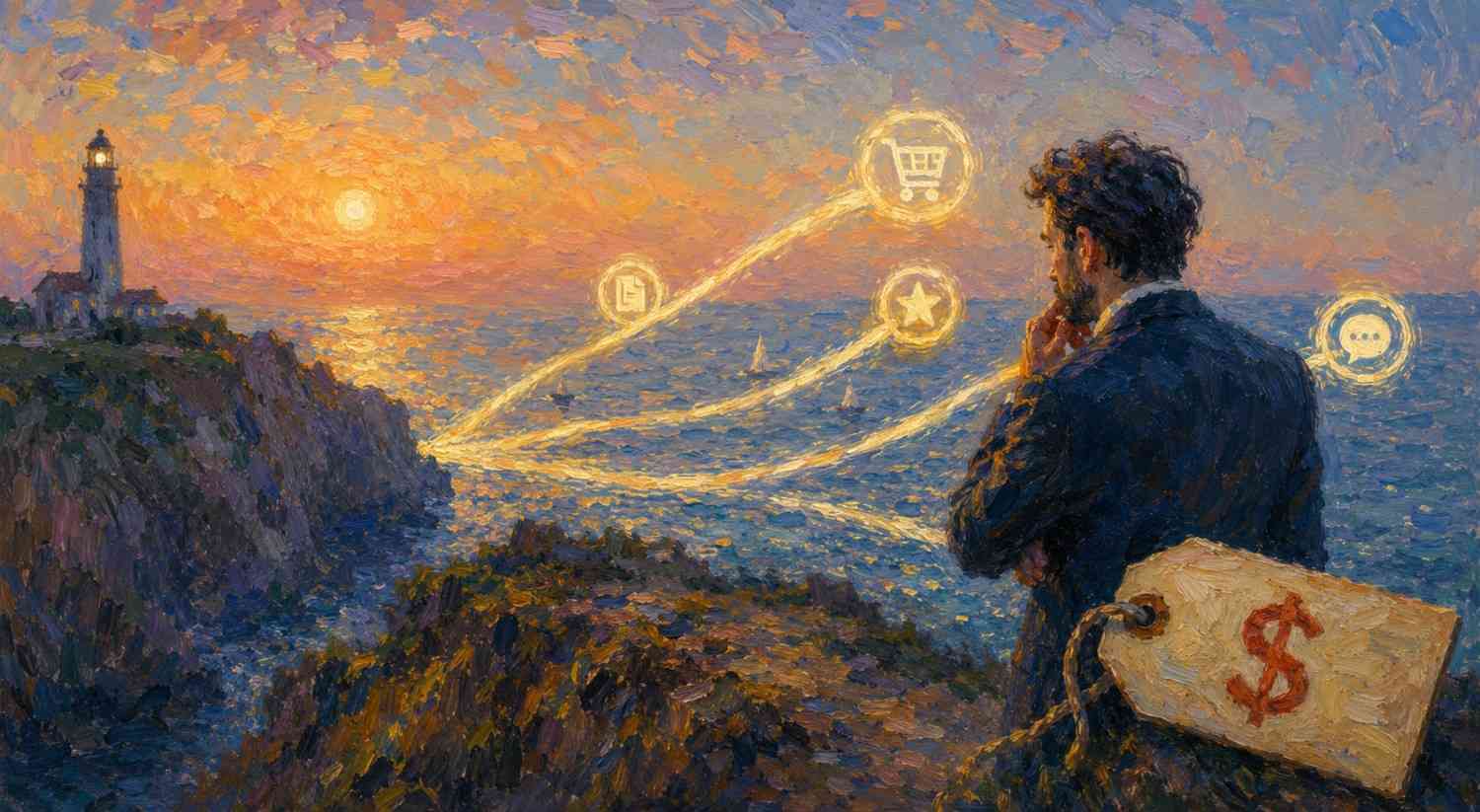
In the agentic web, the citation replaced the click as the moment of influence, and only two of the three parties have a price. Brands can now pay OpenAI to appear near an answer. Publishers whose reporting grounds that answer receive a footnote. A market with a buyer, a seller, and no settlement between them is not a measurement problem.
What DesignRush and Forbes reported, and what we verified
Christina Adame of Intero Digital argues on DesignRush that zero-click search has broken last-click attribution and that budgets are being misallocated as a result. Lior Eldan of Moburst argues in Forbes that generative engine optimization has commoditized and that proprietary evidence, not formatting, is the remaining differentiator. Both diagnoses are correct. Both remain inside the marketing department.
The numbers need a correction. DesignRush cites a rise from 56% to 69%, which is Similarweb's May 2025 reading on news queries, published in July 2025; the Forbes piece cites 60%, closer to a 2024 baseline. The most current comparable figure is 68% of US Google searches ending without a click between January and April 2026, from SparkToro's June 2026 study using Similarweb panel data, and we use that. Pew Research's July 2025 analysis of 68,879 searches remains the cleanest behavioural evidence: 8% click-through when an AI summary is present versus 15% when it is absent, and 1% clicking a link inside the summary itself.
Why better measurement will not fix an unpriced market
The strongest case for fixing measurement first
The measurement-first camp has the better short-term argument. If last-click remains the scoreboard, the content that earns citations looks like a cost centre and gets defunded, exactly as Adame warns. Eldan's supply-side point lands too: Ahrefs found 74.2% of 900,000 new pages carried AI-generated content in April 2025, so structural polish has stopped being a moat, and proprietary data is a real one. Build the baseline, prove the influence, protect the budget.
Why proof of influence without an inventory market only documents the loss
Every measurement-only strategy ends in the same place: a defensible chart of demand you cannot buy. Pew's 1% in-summary click rate is the tell. If almost nobody clicks the citation, then the citation is the impression, and an impression with no rate card is a subsidy paid by whoever produced it. Gartner's 2026 CMO Spend Survey, fielded among 401 CMOs, shows the consequence: 70% call AI leadership critical, 15.3% of budget already flows to AI, and only 30% report mature readiness. That is spend without inventory discipline, which is how latecomer markets get priced expensively.
What this means for brands and for publishers
For CMOs, media buyers and agencies: budget for inventory, not only for dashboards
Treat AI visibility as a media line with a buyer, not as a reporting project. ChatGPT advertising went from pilot to self-serve inside six months, which means the first standardized pricing in the answer layer is being set right now, by whoever is transacting. Agencies should be building the practice before a client asks why a competitor is inside the answer and they are not.
For publishers: price citation, not recovered sessions
Traffic recovery is not coming back, and negotiating leverage is arriving instead. Cloudflare's Pay Per Crawl is evolving into Pay Per Use, charging when content creates value rather than when a bot fetches it, and from September 15, 2026 mixed-use crawlers are blocked by default on ad-carrying pages. The warning from Nieman Lab's May 2026 coverage of licensing marketplaces is the one to act on: intermediary take rates, reportedly around 15% at ScalePost and an estimated 30% at Cloudflare, are being normalized while publishers are still negotiating individually.
Three signals to watch before the end of 2026
Watch whether the major labs strike bulk access deals ahead of Cloudflare's September deadline or litigate it, because that sets the floor price of grounding content. Watch whether any share of AI advertising revenue flows to cited sources, which is the moment citation becomes inventory rather than credit. Watch the take rates: once intermediary margins settle, the economics of the citation economy are fixed for a decade.
Conclusion
Hold on to this: AI Search attribution is not a tracking failure to be dashboarded away, it is an unpriced market, and unpriced markets get priced by whoever shows up first with a rail. Smalk AI is building that rail as a Generative Engine Advertising network, placing native ads for AI agents so brands can buy presence inside answers and the publishers whose content feeds those answers get paid for being the source. What to watch next: the first advertising deal in which a cited publisher takes a defined share, because that is the day the citation economy stops being a metaphor and starts being inventory.