
 Open in Claude
AI is changing search faster than it is changing search advertising. eMarketer's June 2026 forecast says more than 80% of US AI advertising this year will run beside AI-generated answers — not inside them. That single number is the story of AI Search advertising in 2026: the money has found the new surface, but not the new format.
- eMarketer projects US AI ad spend rising from $32.03 billion in 2026 to $68.25 billion in 2030, yet over 80% lands next to AI content like Google AI Overviews, not inside chatbots.
- The US chatbot ad market stays small — under $1 billion in 2026, just over $5 billion by 2030 — far below OpenAI's $100 billion global ambition.
- Beside-the-answer advertising is the old search auction renting a new wall; the native in-answer format, and the publisher payment rail beneath it, do not yet exist.
- Cloudflare data shows AI engines crawling thousands of publisher pages per referral while sending almost nothing back — influence without payment.
- The brands and publishers that build for citation now, rather than wait for the format to prove itself, will compound an advantage the rest pay to catch.
What 'beside the answer' AI Search advertising actually is
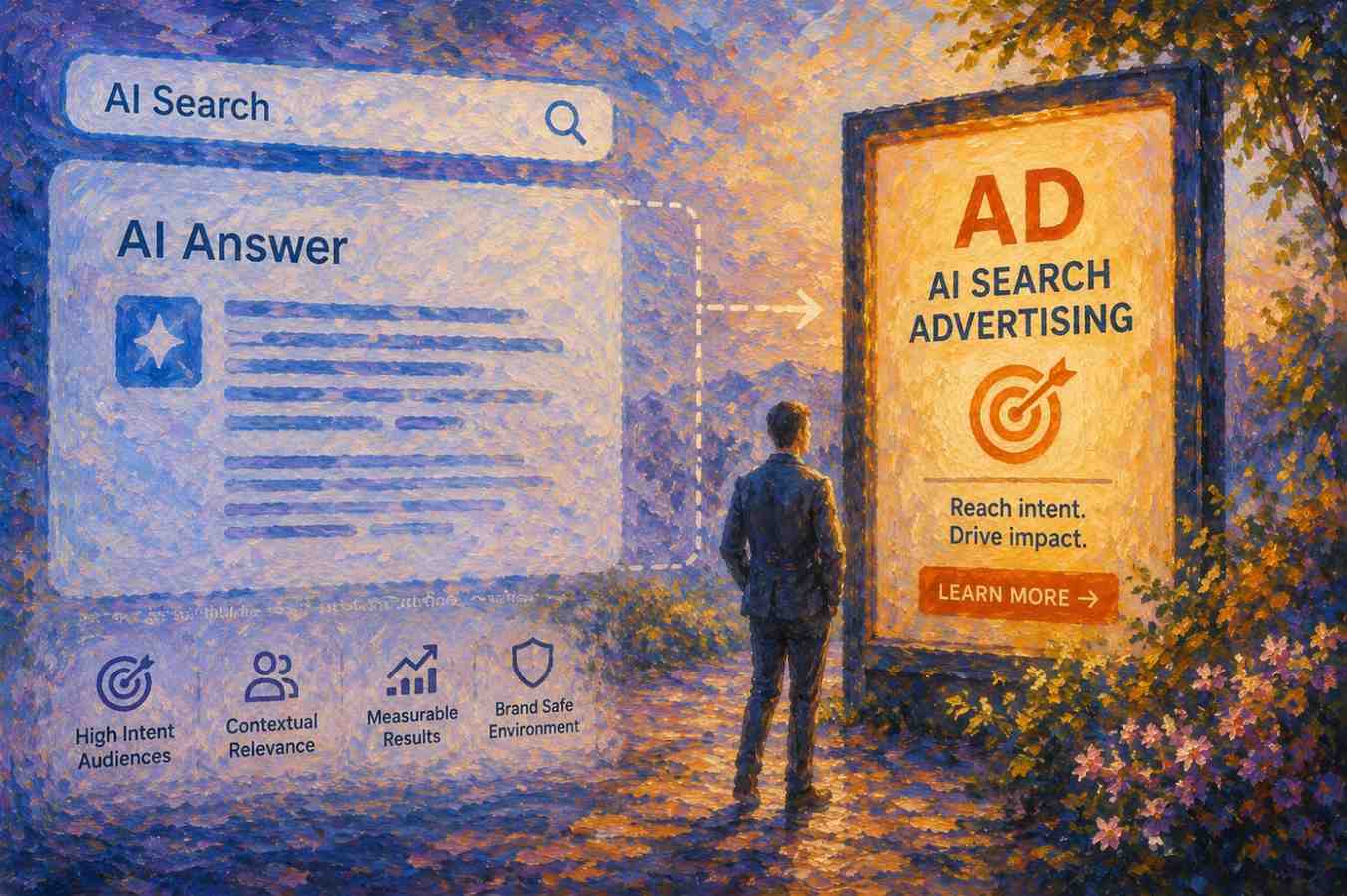
Beside-the-answer advertising is a paid placement that sits adjacent to an AI-generated result — a standard search ad rendered above or below a Google AI Overview — rather than inside the synthesized response itself. It monetizes the page that hosts the answer, not the answer. The distinction matters because the answer is where attention now collects.
The SERP auction and the answer box, side by side
In the open-web economy, brands rented ranked slots on a results page, and publishers earned a cut of the traffic those slots sent. In the agentic web, the user reads one synthesized answer and rarely clicks.
Beside-the-answer ads keep the old auction alive on a shrinking strip of screen. The answer box, where the decision is actually formed, has no native ad layer and no payment rail back to the sources it cites. The auction migrated; the value chain did not.
Beside the answer is the old auction renting a new wall.
— Smalk AI
What eMarketer forecast, and what we checked
eMarketer's 'US AI Advertising Forecast 2026,' authored by principal analyst Nate Elliott on June 4, 2026, projects US AI ad spending more than doubling from $32.03 billion to $68.25 billion by 2030, with over 80% sitting beside AI content throughout. We verified the figures against eMarketer's release and trade coverage; they hold.
One number invites confusion. eMarketer puts the US chatbot ad market — ads inside ChatGPT or Gemini — at just over $5 billion in 2030. WPP Media's mid-2026 forecast puts global generative search advertising above $100 billion by 2030 (from $5.1 billion this year). These do not conflict: WPP's broader category counts ads beside AI Overviews across all markets, while eMarketer isolates the narrow in-chatbot slice. The gap between them is exactly the layer the market has not built.
Why the chatbot-ad slump is real but misread
The strongest version of the bearish case
Elliott's evidence is hard to argue with. ChatGPT's ad CPMs launched near $60 in February 2026 and fell to $25 within nine weeks; eMarketer projects below $15 by 2030. OpenAI opened ChatGPT ads to 700 million users and still tracks far short of its $100 billion target. On today's data, in-conversation advertising faces real pressure on inventory, pricing, and returns. Staying beside the answer looks like the disciplined call.
Why a snapshot is not a destination
But a CPM collapse in a nine-week-old pilot measures the format, not the surface. Current chatbot ads are display units wedged into a conversation — the wrong creative, sold the wrong way, with nothing flowing to the publishers whose content grounds the answer. The slump is evidence that the native format and the payment rail are missing, not that demand to be inside the answer is absent. The 80%-beside figure is a transition artifact, not the equilibrium.
What this means for brands and for publishers
For CMOs, media buyers, and agencies: do not mistake adjacency for visibility
Buying an ad beside an AI Overview is not the same as being named inside the answer. Treat AI Search advertising as a discipline distinct from SEA, with its own owner and KPIs. Ringfence a 2026 test budget for in-answer visibility and citation, audit how much of your funnel already depends on AI-mediated discovery, and resist gutting SEO budgets — the two reinforce each other.
For publishers: stop pricing on traffic recovery
The traffic is not coming back. Cloudflare's mid-2026 data shows leading AI engines crawling thousands of pages for every referral they return — Anthropic above 11,000 to 1, OpenAI near 857 to 1, against Google's roughly 5 to 1 — while every AI chatbot combined sent under 0.3% of referral traffic in May 2026. Price your future on being the cited source of record, and demand a model that pays for citation, not clicks.
Signals to watch before 2027
Three things will tell you when the in-answer layer arrives. First, buying controls: WPP notes brands still cannot purchase or exclude placement adjacent to AI Overviews — when granular controls ship, the format is real. Second, agentic commerce maturity: OpenAI's Instant Checkout launched in late 2025 and was pulled within months, a sign the rails are early. Third, a payment mechanism for cited publishers — the first standard that compensates sources inside the answer will set the category's price.
Conclusion
Hold on to this: AI Search advertising in 2026 has found the new surface but not the new format — money sits beside the answer because nobody has built the native ad layer inside it, or the rail that pays the publishers feeding it. That missing layer is the category Smalk AI is building: generative engine advertising — native ads for AI agents that place brands inside AI-generated answers while opening a new revenue stream for the publishers whose content fuels them. Watch for the first standard that prices a sponsored citation; that is the moment beside-the-answer spending starts moving inside.